Why “Demonstrable Accountability” Matters

Why “Demonstrable Accountability” Matters

Why “Demonstrable Accountability” Matters

Does Your Privacy Program Have ‘Demonstrable Accountability’?

The first Ontario decision to include an Administrative Monetary Penalty (AMP) under the Personal Health Information Protection Act (PHIPA) shows how serious the consequences can be when personal health information (PHI) is used for an unauthorized secondary purpose.

Privacy Breach Nuggets takes real cases and turns them into practical lessons for privacy officers, clinics, and healthcare practices. Let’s dive into what went wrong, what worked, and how you can apply these insights to strengthen your privacy program.

What Happened

This case includes the Windsor Regional Hospital, Chatham-Kent Hospital Alliance, Erie Shores Healthcare, WE Kidz Pediatrics, and Dr. Omar Afandi.

Between April 20 and May 7, 2024, Dr. Afandi accessed the shared electronic health record (EHR) system of CKHA’s Women’s and Children’s Program. He used it to identify newborns so he could contact their parents to offer circumcision services at his private practice, WE Kidz Pediatrics.

Several parents reported receiving these unsolicited calls and complained to the hospitals. Dr. Afandi later stated he did not realize these accesses were unauthorized under PHIPA.

Managing the Breach

We can analyze the hospitals’ and clinic’s response using the 4-Step Response Plan.

Step 1 – Spot and Stop

The breach was reported by patients who received unsolicited contact from the physician.

The Chief of Staff wrote to Dr. Afandi on May 15, 2024, advising that his actions constituted an unauthorized collection and use of PHI and inviting him to withdraw his reappointment application with the hospital.

Step 2 – Investigate

The hospital conducted an internal investigation and notified the Information and Privacy Commissioner (IPC).

Records showed that Dr. Afandi had completed Privacy, Security, and Confidentiality training in October 2020 and had signed a confidentiality agreement with WRH. He also confirmed he reviewed WRH’s privacy module again when he reapplied in April 2024.

Step 3 – Notify

The hospitals reported the breach to the IPC on May 31, 2024, and to the College of Physicians and Surgeons of Ontario on June 1, 2024.

Notification letters were sent to potentially affected families the week of July 2, 2024, describing the incident, the PHI involved, and corrective actions. A hotline was provided for questions.

Step 4 –Prevent the Breach from Happening Again

AMP powers to address a privacy breach signal a new era of active enforcement in Ontario’s health privacy landscape.

Administrative Monetary Penalties (AMPs) came into effect under PHIPA on January 1, 2024. This update to the legislation gives the Information and Privacy Commissioner (IPC) authority to issue AMPs of up to $50,000 for individuals and $500,000 for organizations in cases of PHIPA non-compliance.

In this case, the Commissioner exercised those new powers and fined:

  • Dr. Afandi (individual) – $5,000
  • WE Kidz Pediatrics (clinic as custodian) – $7,500

Both were penalized for unauthorized access and use of PHI for personal gain.

The IPC found that WE Kidz opened without a compliant privacy program — a key factor in the penalty decision. 

WE Kidz was also required to complete privacy training and develop formal privacy policies and procedures. The Commissioner also recommended that WRH improve its record-keeping and monitoring to better demonstrate compliance in future audits.

Commissioner’s Investigation

The IPC emphasized the importance of “demonstrable accountability.”

“Demonstrable accountability” refers to a repeatable and evidence-based system of data governance whereby organizations can show regulators and individuals how they meet their legal and professional responsibilities in practice.

In the data regulatory context, the concept has evolved beyond basic checklist compliance. It now requires organizations to prove that their accountability mechanisms are active and effective — that safeguards are working as intended to reasonably protect personal health information.

In other words, demonstrable accountability means being able to measure, document, and demonstrate that privacy protections are in place, maintained, and effective — not just written in a policy.

Being able to demonstrate compliance is a regulatory expectation under PHIPA — and it’s the key to avoiding costly penalties.
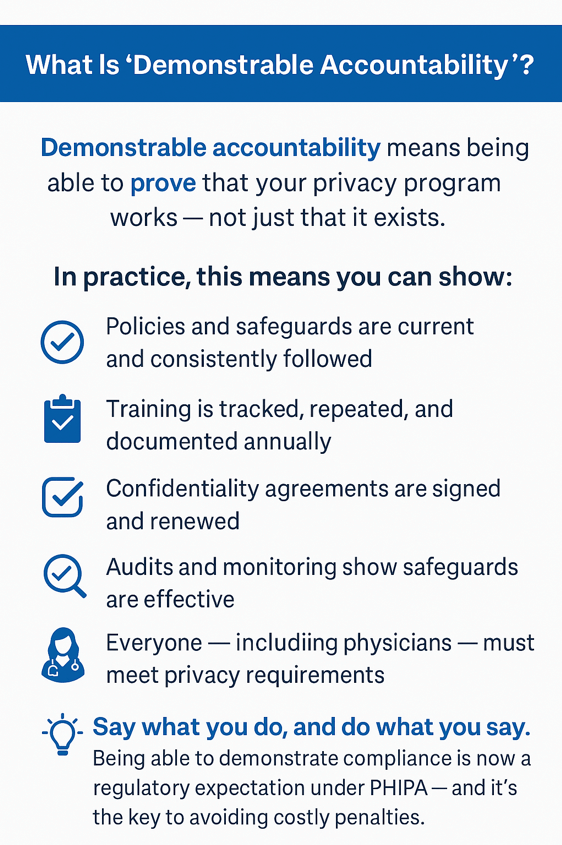
Demonstrable Accountability infographic Information Managers Ltd.

Under Section 10 of PHIPA, custodians must have information practices describing how they collect, use, disclose, retain, and safeguard PHI — and they must comply with those practices in day-to-day operations.

Take-Aways

✅ “Demonstrable accountability” means having evidence that your privacy program is working — not just written policies on a shelf.

✅ Maintain dated policies, training checklists, and signed confidentiality agreements for every team member.

✅ Replace “professional deference” with consistent expectations — all healthcare providers must complete privacy training and demonstrate understanding.

✅ Document and review your privacy program annually to ensure that safeguards and practices are effective in real life.

✅ Unauthorized secondary use of PHI — even for legitimate healthcare services — is a serious breach and can result in financial penalties.

Need Help Training Your Privacy Team?

Join the Practice Management Success Membership to access privacy awareness training, templates, and resources to strengthen your privacy management program.

Reference

Information Privacy Commissioner of Ontario. PHIPA Decision 298. August 28, 2025. https://www.ipc.on.ca/en/decisions/latest-decisions/phipa-decision-298


You May Also Be Interested In

Medical Secretary Fined for Unauthorized Access And Disclosure to Health Information
3rd Largest Fine Ever Under the HIA

Privacy Breach Nugget: Why Documentation Matters in Privacy Breach Investigations

Privacy Breach Nugget: Why Documentation Matters in Privacy Breach Investigations

Investigation Tips Following the NWT Health Authority Incident

When employees make mistakes that result in a privacy breach, the custodian is held responsible to ensure that appropriate investigations are performed. This includes appropriate documentation of the privacy breach incident and sanctions when indicated.

The NWT Information and Privacy Commissioner (IPC) opened an investigation into the Northwest Territories Health and Social Services Authority (NTHSSA) after a reported privacy breach in 2024. This review aimed to assess whether the health authority had adequate safeguards in place to investigate and prevent similar future incidents.

Privacy Breach Nuggets takes real cases and turns them into practical lessons for privacy officers, clinics, and healthcare practices. Let’s dive into what went wrong, what worked, and how you can apply these insights to strengthen your privacy program.

What Happened

In April 2024, a patient filed a complaint with the nurse-in-charge at a health centre in the Northwest Territories. The complaint alleged that a clerk had inappropriately shared the patient’s personal health information with a family member during a casual conversation.

The nurse-in-charge apologized to the patient and escalated the issue to the regional manager. The clerk denied disclosing the health information, but the health authority concluded the incident had indeed occurred.

The Commissioner emphasized that there was no ill intent, stating:

“The interaction between the clerk and the sister was spontaneous and indicates a simple lapse in judgment.”

Managing the Breach

The NTHSSA’s management of the privacy breach can be examined using the 4 Step Response Plan.

Step 1 – Spot and Stop

The privacy breach was identified by the patient and reported to the nurse in charge and escalated to the regional manager.

Step 2 – Investigate

An investigation was initiated. While the clerk denied the allegation, the health authority determined a breach had occurred.

However, the Commissioner noted a serious concern: the investigation was poorly documented. If notes were taken, they could not be located or produced during the review.

Step 3 – Notify

The patient and NTHSSA (the custodian) was aware of the breach. No further notification was required.

Step 4 – Prevent the Breach from Happening Again

The health authority directed the clerk to:

  • Complete updated privacy training
  • Review the oath of office
  • Review patient confidentiality policies

No further disciplinary action was taken.

Commissioner’s Investigation

The IPC made several key recommendations:

  • Equip investigators: Ensure staff who investigate privacy breaches are properly trained and supported to conduct effective, timely, and well-documented investigations.
  • Enforce sanctions: Ensure managers understand the range of disciplinary options available and are aware of their obligation to apply reasonable disciplinary measures when warranted.
  • Annual privacy training: Reinforce the Mandatory Training Policy by ensuring all employees complete refresher privacy training every year.
  • Use real examples: Incorporate this privacy breach as a case study in future privacy training to help employees understand their obligations—at work and outside of work.

Take-Aways

Annual privacy training is not enough.

Training must include real-world, job-relevant examples and emphasize how privacy rules apply in everyday situations.

When employees make mistakes, it’s the custodian’s responsibility to lead an appropriate and well-documented investigation—not just revisit outdated training.

A strong privacy culture includes tools, training, and clarity. Equip your investigators, privacy officers, and managers with the skills they need to respond appropriately.

For more on how to manage privacy-related employee errors, listen to the podcast:

Managing Employees When They Make Mistakes – Episode #105

Need Help Training Your Privacy Team?

Ask me about Practical Privacy Officer Strategies training to strengthen your internal investigation process and build a more resilient workplace.

Reference

NWT IPC File Number: 24-950-6 on April 4, 2025Northwest Territories Health and Social Services Authority (Re), 2025 NTIPC 97 (CanLII), <https://canlii.ca/t/kc0s6>, retrieved on 2025-06-09

You May Also Be Interested In

Medical Secretary Fined for Unauthorized Access And Disclosure to Health Information

3rd Largest Fine Ever Under the HIA

Media Story Reveals Employee Snooping

Media Story Reveals Employee Snooping

Media Story Reveals Employee Snooping

Ontario’s Information and Privacy Commissioner (IPC) opened an investigation into a hospital’s management of employee snooping after three similar privacy breach reports were received from the hospital in 2020 and 2021. The IPC elected to review the privacy breach to ensure that the custodian had adequate safeguards to prevent similar instances.

The investigation found that the hospital had managed the breaches well and no recommendations were required, and findings were published in PHIPA Decision 204.

In this Privacy Breach Nugget series, I will take a look at each of these three incidents as guidance to better respond to a privacy breach in your healthcare practice.

What Happened

A news media story was published containing the names of patients at an Ontario hospital. The hospital Privacy Office initiated an audit which found that a Patient Accounts Clerk had accessed 28 health records without authorized purpose. This snooping is in contravention of the Personal Health Information Protection Act (PHIPA).

Managing the Breach

The Ontario Hospital’s management of the privacy breach can be examined using the 4 Step Response Plan.

4-Step Response Plan


Step 1 – Spot and Stop

The privacy breach was detected by the hospital when the media story aired. The hospital ran a preliminary audit on the health records of those patients named in the story that found suspicious access by an accounts clerk. Once identified, the hospital disabled the clerk’s access to the electronic health record (EHR) system and put them on administrative leave.

Step 2 – Investigate

After identifying the clerk, the hospital initiated second and third audits on their EHR accesses and found 28 patients whose records were accessed without authorized purpose. This is also known as employee snooping. The investigation established that those patients had been deliberately searched for in the EHR system, confirmed with the clerk’s manager that no authorized purpose was given to do so, and that the clerk had previously signed a Statement of Confidentiality and completed privacy and security awareness training.

Step 3 – Notify

The hospital notified those patients affected by the breach by telephone or mail. Under PHIPA s. 12(2), it is mandatory for custodians providing services in Ontario to notify patients whose personal health information has been used or disclosed without consent or authorized purpose.

Notification in this case was delayed for compassionate reasons as some of the health information accessed was from a deceased patient. One patient was not able to be contacted, and a note on their file was made for the registration department to notify the hospital’s Privacy Office the next time the patient registered at the hospital. The patient will be informed of the privacy breach on their return visit to the hospital.

The hospital also notified the IPC of the incident. It is mandatory for a custodian providing services in Ontario to report a privacy breach of personal health information to the IPC (PHIPA regulation s. 6.3 pursuant to PHIPA s. 12.3.)

Step 4 –Prevent the Breach from Happening Again

The hospital considered disciplinary action with the clerk; however, the clerk retired before any actions were taken. Policies and procedures at the hospital were reviewed, and changes made to immediately notify deceased patients’ families of a privacy breach going forward. The hospital’s Privacy Officer will now work closely with the Human Resources department to ensure more consistent investigations.

Commissioner’s Investigation

In the IPC report, the investigation also noted some positive measures taken by the hospital in managing privacy risks:

  • All new staff receive privacy awareness training and sign Statements of Confidentiality. Annual refresher training with new Statements of Confidentiality is mandatory.
  • The hospital’s Privacy Office communicates with staff on privacy issues during a yearly email campaign called Privacy Awareness Week.
  • The hospital’s Privacy Officer holds training sessions when requested or new information is available.
  • The hospital’s EHR system displays a privacy advisory reminder that staff must agree to before accessing information.
  • Policies and procedures are reviewed and amended every three years and when needed.
  • Policies and procedures, and investigation findings are properly documented.
  • As a result of this incident, the hospital outlined a plan to respond to the breaches and the investigation, and to future breaches involving patients who are deceased. These include updating privacy awareness training with examples of snooping similar to those investigated and sending quarterly emails to staff about access without authorized purpose and how to prevent privacy breaches.

Take-Aways

The hospital had pre-existing privacy awareness training and privacy breach management procedures. A review in response to the incident led the hospital to amend their notification procedures for privacy breaches involving deceased patients. Notification to the family will be made immediately in future when breaches involve a deceased patient.

You might need to consider modifying your policies and procedures, too, to include a similar scenario.

Watch for the next article where we share example #2 in IPC Decision 204.

Article submitted by: Aaron Myer

Reference

Ontario Regulation 329/04. Government of Ontario, 2006, https://www.ontario.ca/laws/regulation/040329#BK6. Accessed 9 June 2023.

Personal Health Information Protection Act, 2004. Government of Ontario, 2004, https://www.ontario.ca/laws/statute/04p03. Accessed 9 June 2023.

PHIPA Decision 204. Information and Privacy Commissioner of Ontario, 4 Apr. 2023, https://decisions.ipc.on.ca/ipc-cipvp/phipa/en/521298/1/document.do. Accessed 9 June 2023.