
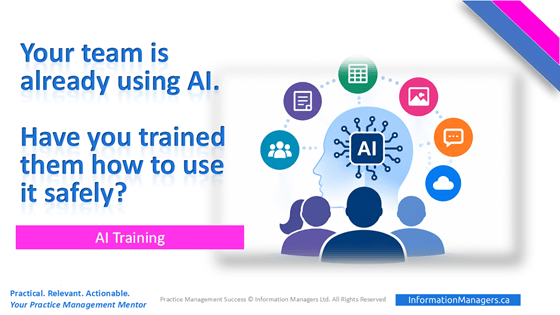
Your Healthcare Team Is Already Using AI. Have You Trained Them to Use It Safely?
The Hidden Risk: Employees Are Using AI Without Training
“This AI tool is amazing!”
Imagine this:
One of your clinic employees discovers a new whiz-bang AI tool that promises to slash their workload.
It’s easy to use, the results look impressive, and best of all, there’s a free version!
The employee decides to try it out and uploads a spreadsheet to help organize staff schedules.
Then someone asks, “Did you just share our employee list with AI?”
Oops.
The employee hadn’t considered that uploading the spreadsheet might disclose personal information to an external service provider.
There was no malicious intent. The employee was simply trying to be more efficient.
This is exactly why AI safety training for healthcare teams matters.
Employees may be comfortable using AI tools without understanding the privacy, security, accuracy, and professional responsibilities that come with them.
AI Literacy Is Not the Same as AI Safety
Many healthcare employees already use AI in their personal lives. They may use ChatGPT to draft messages, research topics, or organize information.
However, using AI at work introduces additional responsibilities.
Healthcare employees need to understand:
- Privacy and confidentiality: What patient, employee, and business information must not be entered into unapproved AI tools?
- Approved AI tools: Which applications are authorized by the clinic, and for what purposes?
- Accuracy and reliability: How can AI generate convincing but incorrect information?
- Human oversight: Who is responsible for reviewing and verifying AI-generated content before it is used?
- Transparency: When should patients and colleagues be informed that AI is being used?
- Accountability: What should employees do if they accidentally share confidential information with an AI application?
AI safety training helps employees recognize these risks before a privacy breach, clinical error, or other incident occurs.
AI Training for Healthcare Is Part of Your Privacy Management Program
In Canadian healthcare practices, protecting personal health information is already a fundamental responsibility.
Introducing AI doesn’t remove those obligations. It creates new situations in which employees must apply them.
For example, an employee might use an AI tool to summarize a patient complaint, draft a referral letter, or analyze clinic operations.
Even if the employee believes the information has been de-identified, it may still contain details that could identify an individual.
Your clinic’s privacy and security policies should address AI use. But policies alone aren’t enough.
Employees need practical training to understand what those policies mean in their day-to-day work.
AI awareness training should be included in your onboarding program, reinforced through ongoing privacy awareness activities, and updated as your clinic introduces new AI tools.
Don’t Let Employees Bring Their Own AI to Work
One of the messages I emphasize in my privacy consulting work is:
Implementing AI in a healthcare practice is a business and custodian decision—not an individual staff decision.
The clinic’s leadership and responsible health information custodian must determine whether an AI application is appropriate for the practice and ensure that applicable privacy, security, and professional requirements are addressed.
Before implementing an AI application, the clinic should assess the vendor, intended uses, privacy and security safeguards, contractual requirements, and any applicable privacy impact assessment obligations.
This applies to free AI tools, paid subscriptions, AI scribes, AI receptionists, and other applications.
It also applies to locums, contractors, and temporary employees.
Employees should not independently introduce AI tools into clinic workflows simply because they are convenient, free, or promise to save time.
AI safety training helps employees understand who can authorize AI tools, which tools they are permitted to use, and when they must seek approval before trying something new.
Start With AI Safety Training for Healthcare Teams
You don’t need every employee to become an AI expert.
You do need everyone to understand the fundamentals of safe and responsible AI use.
A good starting point is practical, role-appropriate training that explains how AI works, what it can and cannot do, common risks, and when to ask questions before using it.
This gives your team a foundation for making better decisions, recognizing potential problems, and using approved AI tools more confidently.
The goal is not to discourage AI adoption. It is to help your team use AI safely, responsibly, and with appropriate human oversight.
AI Safety Essentials for Healthcare Teams
During my October 13 Q&A with Jean, I welcomed Anne Genge of Myla Training to discuss why AI safety training is important for healthcare teams.
Anne shared practical insights about AI awareness, the risks of unapproved AI use, and the importance of preparing employees before introducing AI into healthcare workflows.
I also completed Myla Training’s AI Safety Essentials for Healthcare Teams course myself.
I found the course practical, well-presented, and easy to follow, with relevant examples for healthcare. I particularly appreciated the module on AI agents, which made a complex topic easier to understand.
I recommend this course to healthcare clinic owners, managers, privacy officers, and employees who want a better understanding of how to use AI safely at work.
Take the Next Step: Train Your Team on AI Safety
Don’t assume your employees already know how to use AI safely.
Give them the knowledge and confidence to recognize AI risks, protect confidential information, and make informed decisions.
Explore Myla Training’s AI Safety Essentials for Healthcare Teams course and receive a 10% discount using my referral link.
Affiliate disclosure: This is my affiliate link. You receive a 10% discount when you use the link, and I receive a small commission. There is no additional cost to you.
You Might Also Be Interested in These Articles…
AI Scribes in Canada
Learn about AI scribe initiatives in Canada, AI governance, privacy impact assessments, and the importance of approving AI tools before introducing them into your healthcare practice.
Thinking About Using AI Scribe in Your Healthcare Practice?
Explore the benefits and privacy considerations of AI scribes, including patient notification, vendor selection, and responsible implementation.