

Your Locum Has an AI Scribe. Is It Approved for Use in Your Clinic?
Prevent Shadow AI: Make Sure Locums Follow Your Clinic’s Privacy Policies and Procedures
You’ve arranged for a locum healthcare provider to cover your practice. Great! You’ve organized the schedule, prepared EMR access, and made sure everything is ready.
But have you asked one important question?
“Are you planning to use an AI tool while working in our clinic?”
Your locum may already be using an AI scribe. They may love it! It saves time, reduces documentation workload, and helps them focus on patient care.
But just because the locum is familiar with an AI tool doesn’t mean that it has been approved for use in your clinic.
And that’s where privacy risks can begin.
What Is Shadow AI?
Shadow AI happens when employees, contractors, or healthcare providers use artificial intelligence tools for work without the organization’s knowledge or approval.
Imagine a locum who arrives at your clinic with their favourite AI scribe already installed on their mobile phone.
They begin recording patient encounters and generating clinical notes, assuming it’s acceptable because they’ve used the application elsewhere.
But your clinic hasn’t reviewed the AI vendor, completed the necessary privacy assessment, or confirmed where the patient information is stored and processed.
You haven’t provided patients with the appropriate notice about AI use or obtained their acknowledgement.
Perhaps the audio recordings remain on the locum’s personal device. Perhaps the vendor retains information longer than your clinic permits.
Now you have a potential privacy breach—and a problem that could have been prevented with better preparation.
Custodians: Your Clinic’s Rules Still Apply
Locums are valuable members of your healthcare team. They bring experience, flexibility, and much-needed coverage.
But they also need to understand and follow your clinic’s privacy and security policies and procedures.
As a custodian responsible for health information, you need to establish clear expectations about how patient information is collected, used, disclosed, stored, and protected.
That includes the use of AI tools.
You don’t have to prohibit AI. You do need a process to determine which AI applications are appropriate for your clinic and how they may be used.
If a locum wants to use an AI tool that your clinic hasn’t approved, there should be a process to request a review before the tool is used with patient information.
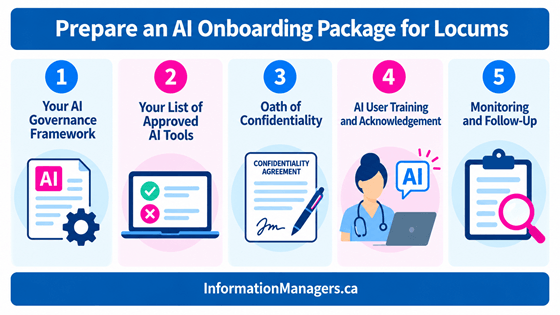
Prepare an AI Onboarding Package for Locums
One of the easiest ways to prevent shadow AI is to prepare an AI onboarding package that you can share with every locum before they begin working in your practice.
Your package should include:
1. Your AI Governance Framework
Explain your clinic’s rules for adopting and using AI tools. Identify who approves new AI applications, what assessments are required, and the responsibilities of healthcare providers.
2. Your List of Approved AI Tools
Identify approved applications and explain that personal AI accounts and unapproved tools must not be used with patient information.
3. Oath of Confidentiality
Ensure the locum acknowledges your clinic’s confidentiality, privacy, and security requirements. Professional experience doesn’t replace the need to follow your organization’s policies.
4. AI User Training and Acknowledgement
Don’t assume that because someone knows how to use an AI application, they know how to use it safely in your clinic.
Provide practical instructions about patient notices and consent where applicable, audio recording and deletion, transferring AI-generated notes into the EMR, and reviewing AI-generated content.
5. Monitoring and Follow-Up
Your responsibility doesn’t end when the locum signs the acknowledgement.
Confirm that approved tools are being used appropriately. Address questions, reinforce expectations, and document your follow-up.
Remember: AI Doesn’t Replace Professional Judgment
An AI scribe may generate a draft clinical note, but the healthcare provider remains responsible for reviewing the documentation for accuracy, completeness, and appropriateness before it becomes part of the patient record.
AI-generated documentation can contain errors, omissions.
Your AI policies and training should make that responsibility clear.
Don’t Wait Until the Locum Arrives
Imagine how much easier this conversation will be if you have already prepared your AI onboarding package.
Before the locum’s first day, you can explain:
“Here are the AI tools we’ve approved for use in our clinic. Here’s how we use them safely. If you would like to use a different application, please talk to us first.”
That’s a much better conversation than discovering an unapproved AI tool after patient information has already been shared.
Your goal isn’t to make life difficult for locums. It’s to help them provide excellent patient care while protecting the privacy and security of your patients’ information.
Your Next Step: Download the AI Governance Framework
Do you have an AI Governance Framework for your healthcare practice?
If not, now is a good time to get started.
An AI Governance Framework helps your clinic establish clear expectations for approving, implementing, and monitoring AI tools—including those used by locums, contractors, and employees.
Download the AI Governance Framework Template to help you develop practical rules for responsible AI use in your healthcare practice.
Get Your AI Governance Framework Template
You Might Also Be Interested in These Articles…
AI Scribes in Canada
Learn about AI scribe initiatives in Canada, AI governance, privacy impact assessments, and the importance of approving AI tools before introducing them into your healthcare practice.
Thinking About Using AI Scribe in Your Healthcare Practice?
Explore the benefits and privacy considerations of AI scribes, including patient notification, vendor selection, and responsible implementation.